Gáivuotna - Kåfjord - Kaivuono
Gáivuotna - Kåfjord - Kaivuono had 1,939 residents on 1 January 2026. Median household income after tax was NOK 591,800 in 2024, 9% below the county level. 25% of households rented their home. The population has fallen by 1.8% since 2024.
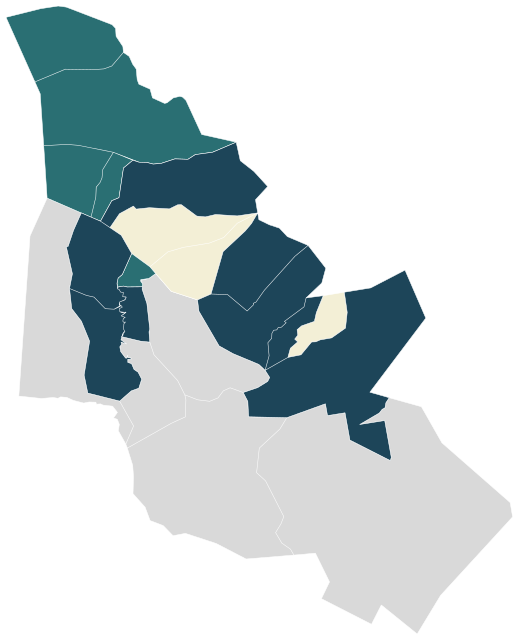
Sources: Statistics Norway (SSB), StatBank (CC BY 4.0) · © Norwegian Mapping Authority, basic statistical units (CC BY 4.0) · © OpenStreetMap contributors (ODbL)
All 16 neighbourhoods.
Colour shows where each one sits among the others in the table, from lowest to highest.
| Neighbourhood | Residents | 67+ | Under 16 | Per km² | Green 500 m | Services 15 min |
|---|---|---|---|---|---|---|
| Birtavarre | 264 | 22% | 14% | 6 | 41% | 5 |
| Djupvik | 130 | 31% | 11% | 7 | 28% | 4 |
| Kjerringdalen | 175 | 22% | 16% | 6 | 36% | 0 |
| Kåfjorddalen | 125 | 38% | 10% | 1 | 55% | 3 |
| Langnes | 33 | 39% | 9% | 2 | 0% | 0 |
| Løkvoll | 141 | 31% | 10% | 54 | 24% | 4 |
| Melnes | 74 | 45% | 8% | 7 | 58% | 2 |
| Nedre Manndalen | 183 | 21% | 17% | 19 | 88% | 0 |
| Nordmannvik | 33 | 33% | 18% | 0 | 23% | 1 |
| Olderdalen | 277 | 25% | 15% | 38 | 26% | 15 |
| Samuelsberg | 140 | 27% | 7% | 6 | 31% | 6 |
| Skattvoll | 50 | 46% | 6% | 4 | 0% | 0 |
| Soleng | 69 | 19% | 23% | 1 | 68% | 0 |
| Storslett | 75 | 32% | 0% | 3 | 0% | 0 |
| Trollvik | 75 | 39% | 8% | 2 | 40% | 1 |
| Ysteby | 43 | 30% | 7% | 4 | 23% | 0 |
Sources: Statistics Norway (SSB), StatBank (CC BY 4.0) · © OpenStreetMap contributors (ODbL)
People.
Age on 1 January 2026, next to the figure for Troms.
Population on 1 January
Source: Statistics Norway (SSB), StatBank (CC BY 4.0)
Income and work.
Income in 2024, employment in late 2025 and education in 2025.
Education, aged 16 and over
Income after tax is a household’s total income minus tax and negative transfers, for private households in 2024. The median is the middle value, so a few high incomes do not pull it up.
Source: Statistics Norway (SSB), StatBank (CC BY 4.0)
Homes.
1,319 homes in 2026.
Households by tenure, 2025
Homes by type of building
Source: Statistics Norway (SSB), StatBank (CC BY 4.0)
Everyday life.
4 everyday shops and services within a 15-minute walk; 39% green space within 500 metres.
Services and green space are measured from each area’s service centre: the point inside it with the most shops and services within 500 metres. District, municipal and county figures are averages weighted by population.
Source: © OpenStreetMap contributors (ODbL)
Around here.
Photographs taken near Gáivuotna - Kåfjord - Kaivuono, shared on Wikimedia Commons under free licences.

i
Photo: Carsten Frenzl from Obernburg, Deutschland · CC BY 2.0
View on Wikimedia Commons


i
Photo: Carsten Frenzl from Obernburg, Deutschland · CC BY 2.0
View on Wikimedia Commons


i
Photo: Carsten Frenzl from Obernburg, Deutschland · CC BY 2.0
View on Wikimedia Commons

Other municipalities in Troms.